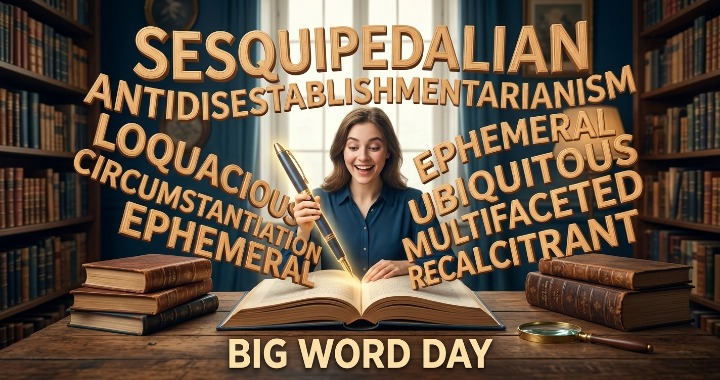
#Language is one of the most #powerfultools #humanity possesses, and #words shape the way we #think, #communicate, and #connect. Celebrated on 21st April, #BigWordDay encourages #people to embrace #rich vocabulary and explore the #beauty of expressive #language. This day is not about sounding complicated but about appreciating the #depth and #precision that #words can bring to #communication. Whether you are a #student, #writer, or #professional, using the right words can elevate your #confidence and #clarity. Big Word Day inspires #curiosity, #learning, and the #joy of discovering new #words that make #conversations more #meaningful and #impactful.
History of Big Word Day
Big Word Day is closely associated with the birthday of Robert Taylor, an American publisher who founded The Old Farmer’s Almanac for Kids. He was passionate about encouraging young minds to learn new and interesting words. The day was established to honour his efforts in promoting literacy and vocabulary enrichment among children.
Although the exact year of formal recognition varies in informal celebrations, Big Word Day has been observed for several decades as part of educational and literacy-focused initiatives. Schools, libraries, and educational platforms gradually adopted the day to promote reading habits and vocabulary building.
Robert Taylor believed that learning big words should not be intimidating but exciting. His idea was simple yet powerful: when people expand their vocabulary, they expand their thinking. Over time, Big Word Day evolved into a celebration not just for children but for learners of all ages who wish to improve their communication skills.
Importance of Big Word Day
Big Word Day holds significant importance in today’s fast-paced digital world where communication is often shortened and simplified. The day reminds us of the richness of language and why vocabulary still matters.
Firstly, a strong vocabulary enhances communication skills. When individuals know more words, they can express ideas more clearly and precisely. This reduces misunderstandings and improves both personal and professional interactions.
Secondly, vocabulary development is directly linked to cognitive growth. Learning new words stimulates the brain, improves memory, and enhances analytical thinking. It allows individuals to process complex ideas more effectively.
Thirdly, Big Word Day promotes reading habits. Books, articles, and literature expose readers to diverse vocabulary. This habit not only improves language skills but also broadens knowledge across various subjects.
Another important aspect is confidence. People who have a good command of language often feel more confident while speaking, writing, or presenting ideas. This can open doors to better career opportunities and social interactions.
Why the Date is Chosen for Big Word Day
The date 21st April was chosen to mark the birthday of Robert Taylor, the visionary behind promoting vocabulary learning among young readers. By aligning the celebration with his birthday, the day serves as a tribute to his contributions to literacy and education.
Choosing a specific date also helps create awareness and encourages institutions like schools and libraries to organize events such as vocabulary competitions, reading sessions, and word games. April, being part of the academic calendar in many countries, is also an ideal time to promote educational activities, making the celebration even more meaningful.
Significance of Big Word Day
The significance of Big Word Day goes beyond just learning difficult or uncommon words. It emphasizes the value of language as a tool for empowerment.
One of the key aspects is intellectual growth. Learning new words enhances knowledge and helps individuals understand complex topics more easily. It bridges the gap between basic understanding and advanced comprehension.
Another significant factor is cultural appreciation. Language carries culture, and words often have historical and cultural significance. By learning new words, individuals also learn about different cultures and perspectives.
Big Word Day also plays an important role in education. Teachers use this day to encourage students to participate in vocabulary-building activities, spelling bees, and creative writing exercises. These activities make learning fun and interactive.
Additionally, the day highlights the importance of effective communication in the professional world. Whether it is writing emails, preparing reports, or giving presentations, a strong vocabulary can make a significant difference.
How Citizens are Affected
Big Word Day has a positive impact on citizens in various ways, both directly and indirectly.
For students, the day encourages learning beyond textbooks. It motivates them to explore dictionaries, read books, and engage in word-based games. This not only improves academic performance but also builds lifelong learning habits.
For professionals, improved vocabulary enhances communication skills, which is crucial in workplaces. Clear and precise communication leads to better teamwork, productivity, and leadership.
For writers and content creators, Big Word Day serves as inspiration to use language creatively. It encourages them to experiment with words and improve their storytelling abilities.
In everyday life, citizens benefit by becoming more articulate. Whether it is expressing emotions, sharing opinions, or engaging in discussions, a rich vocabulary makes communication more effective and meaningful.
Moreover, the day fosters a culture of learning and curiosity. It reminds people that learning does not stop with formal education and that expanding vocabulary is a continuous process.
10 Famous Quotes for Big Word Day
-
“Words are, of course, the most powerful drug used by mankind.”
-
“The limits of my language mean the limits of my world.”
-
“One forgets words as one forgets names. One’s vocabulary needs constant fertilizing.”
-
“Kind words can be short and easy to speak, but their echoes are truly endless.”
-
“Words are free. It’s how you use them that may cost you.”
-
“A word after a word after a word is power.”
-
“Good words are worth much and cost little.”
-
“The difference between the right word and the almost right word is like lightning and a lightning bug.”
-
“Words can inspire. And words can destroy. Choose yours well.”
-
“Language is the dress of thought.”
FAQs on Big Word Day
1. What is Big Word Day?
Big Word Day is a celebration dedicated to learning and using new and complex words to enhance vocabulary.
2. When is Big Word Day celebrated?
It is celebrated every year on 21st April.
3. Who started Big Word Day?
It is associated with Robert Taylor, who promoted vocabulary learning.
4. Why is Big Word Day important?
It helps improve communication skills, cognitive abilities, and confidence.
5. Is Big Word Day only for students?
No, it is for people of all ages who want to improve their vocabulary.
6. How can I celebrate Big Word Day?
You can read books, learn new words, play word games, or participate in quizzes.
7. What are “big words”?
Big words are advanced or less commonly used words that add depth to communication.
8. Does using big words make communication better?
Yes, when used appropriately, they improve clarity and expression.
9. Can learning new words improve intelligence?
It enhances cognitive skills and understanding, which contributes to intellectual growth.
10. Are dictionaries useful for Big Word Day?
Yes, they are one of the best tools for learning new words.
11. How many words should I learn daily?
Even learning 2–3 new words daily can make a big difference over time.
12. Is reading necessary for vocabulary building?
Yes, reading is one of the most effective ways to learn new words.
13. Can children celebrate Big Word Day?
Absolutely, it is especially beneficial for children.
14. What activities are done on this day?
Word games, spelling competitions, reading sessions, and quizzes.
15. Does vocabulary affect career growth?
Yes, strong communication skills are highly valued in professional settings.
16. Are big words always difficult?
Not necessarily; they may seem difficult initially but become easy with practice.
17. Can I use apps to learn new words?
Yes, many apps are designed for vocabulary building.
18. Why do people avoid using big words?
Some fear sounding complex or being misunderstood.
19. How can I remember new words?
Practice using them in sentences and conversations.
20. Is Big Word Day celebrated worldwide?
Yes, it is recognized globally, especially in educational communities.
Conclusion
Big Word Day is more than just a celebration of complex vocabulary—it is a celebration of knowledge, communication, and personal growth. In a world where quick messages and abbreviations dominate, this day reminds us of the beauty and power of language. Words have the ability to inspire, educate, and connect people across cultures and generations.
By embracing Big Word Day, individuals take a step toward becoming better communicators and lifelong learners. Whether through reading, writing, or simply learning a new word each day, the journey of vocabulary building is both rewarding and empowering. Ultimately, the more words we know, the better we understand the world—and the more effectively we can express our place within it.
|
!!! Stay Updated !!! 👉 Follow and Join us on 👈 📰 Trending News | 📢 Important Alerts | 💼 Latest Jobs LinkedIn | Threads | Facebook |Instagram | Tumblr 📱 Follow us daily & never miss an update 📱
|


Someshwar Chowdhury is a seasoned Chartered Mechanical Engineer, Educator, and Technology enthusiast with over a decade of experience in engineering education and consultancy. Someshwar is also an active blogger, trainer, and member of professional bodies like ISHRAE and GREEN ADD+. When not teaching or consulting, he enjoys blogging, music, and exploring green technologies.
Discover more from Today's Significance
Subscribe to get the latest posts sent to your email.