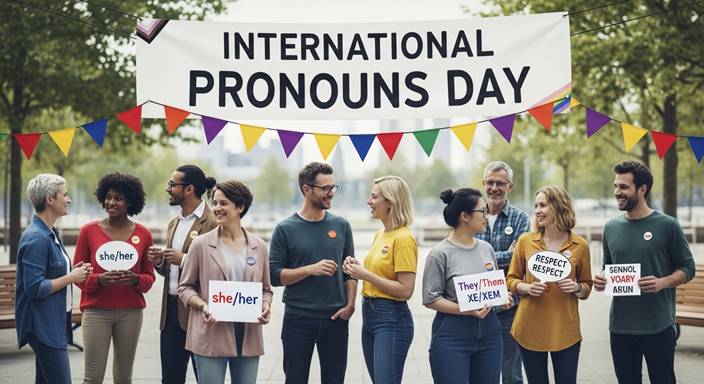
On this year’s celebration of International Pronouns Day (#InternationalPronounsDay), we come together to honour the simple yet profound act of recognizing the #pronouns people use to identify themselves. This day is about more than #grammar—it’s about #dignity, #inclusion and #affirmation. It reminds us that when we respect someone’s pronouns, we are acknowledging their #identity and #humanity. As we pause to observe #PronounsDay, we invite each one of us to #reflect, #share and #engage in practices that uplift all #voices and #identities.
History of International Pronouns Day
International Pronouns Day began in 2018 as a grassroots initiative to promote awareness about personal pronouns and their significance.
The driving force behind the day includes activists and educators working toward gender inclusivity, and although no single large organisation exclusively owns the day, it was established to fill a gap in education about pronoun use and gender identity.
Since its inception, the day has grown in reach and recognition. For example, universities, schools, workplaces, and community organisations now mark it annually.
Importance of International Pronouns Day
Why does this day matter? Simply put: words matter. The pronouns we use when referring to a person are not trivial—they are a reflection of our respect and recognition of that person’s identity.
Using the correct pronouns validates and acknowledges someone’s experience, especially for transgender, nonbinary, and genderdiverse people. The act of mispronouncing or misgendering someone (intentionally or not) can be harmful—it can alienate, erase, or demean.
Moreover, when pronoun sharing becomes commonplace, it normalises the idea that we cannot assume someone’s gender or identity simply by appearance or name. It encourages inclusive language practices in schools, workplaces and social interactions.
In essence, International Pronouns Day is important because:
-
It fosters empathy and respect.
-
It signals to people of all genders that they are seen and valued.
-
It challenges assumptions and promotes inclusive communication.
-
It contributes to safer, more welcoming environments for gender-diverse individuals.
When International Pronouns Day Is Celebrated?
International Pronouns Day is celebrated each year on the third Thursday of October.
For 2025, that falls on Wednesday, 16 October 2025.
The choice of the third Wednesday gives flexibility and consistency—it situates the day in mid-October, allowing schools, workplaces, organisations and community groups to plan events during the academic and professional calendar. While there’s no deeper historical reason for that specific Wednesday beyond establishing a reliable annual schedule, the regular placement helps to integrate it into institutional calendars and awareness campaigns.
Significance of International Pronouns Day
The significance of International Pronouns Day is multifaceted:
-
Affirmation of identity: For many people, selecting and using the correct pronouns is a core facet of how they identify and present themselves. Honouring that affirms their personhood.
-
Language and power: Pronouns are a fundamental piece of language; they shape how we refer to and relate with one another. When the default is assumption (he/him or she/her) without asking, it reinforces binary gender norms. This day challenges that norm. (As noted, some languages don’t even gender pronouns, which further highlights how culturally specific gendered language can be.)
-
Community & belonging: Recognising pronouns helps build inclusive communities. It reduces micro-aggressions, supports mental wellbeing, and signals that difference is respected rather than erased.
-
Education & change: The day opens conversations in schools, workplaces, religious communities, and social groups about how we use language, how we assume gender, and what inclusive behaviour looks like.
In short: International Pronouns Day is significant because it touches on respect, equity, language, identity and culture all at once.
Why International Pronouns Day Is Celebrated
We celebrate International Pronouns Day because it provides a dedicated moment to focus on pronoun awareness and inclusive language. Without special attention, many organisations or individuals may overlook pronoun practices or assume they are “minor issues”. This day brings attention and intention.
Additionally, celebrating the day:
-
Encourages people to share their own pronouns, thereby normalising the practice.
-
Promotes the habit of asking someone’s pronouns rather than assuming.
-
Allows institutions to review and improve their forms, directories, name tags, e-mail signatures, social media profiles etc. to reflect inclusive practices.
-
Provides a platform for stories—people share why their pronouns matter, what misgendering felt like, what respect means.
-
Serves as a reminder that inclusive language is not just one day’s work—it’s part of ongoing culture change.
In essence, we celebrate to build momentum, visibility, and commitment to inclusion—not just for one day, but for every day.
How International Pronouns Day Is Celebrated
Celebrations of International Pronouns Day vary widely around the world, but commonly include:
-
Workshops or educational sessions in schools, universities, community centres and workplaces about the importance of pronouns and inclusive language.
-
Pronoun-sharing activities: people put their pronouns in their email signatures, on name badges, on social media bios; they may wear pronoun buttons or stickers.
-
Discussions and panel events—sometimes hosted by LGBTQ+ resource centres, inclusive-language advocates, or diversity & inclusion departments.— They may include Q&A sessions, resource-sharing, pronoun-practice games.
-
Social media campaigns using hashtags like #PronounsDay, #MyPronounsAre, #ShareYourPronouns to raise awareness and invite people to share their pronouns publicly.
-
In workplaces, organisations might review policies, add pronoun fields in forms, train staff on pronoun etiquette, create “pronoun-friendly” communications.
-
In academic settings, libraries, campus resource centres might host tabling events, provide pronoun stickers, create educational materials or infographics.
-
In religious or community settings, the day may be used to include pronoun awareness in liturgy, sermons, or community discussions.
-
Digital celebrations: webinars, virtual backgrounds, pronoun-sharing graphics for Zoom/Teams, online discussion forums.
Because the event is grassroots and decentralized, the scale and style of celebration depends on local context—but the shared aim is the same: elevate pronouns, respect identity, invite inclusion.
Which Countries / Parts of Countries
While International Pronouns Day is centred largely in the English-speaking world (U.S., U.K., Canada, Australia, etc.), its influence is increasingly global. Many universities, organisations and LGBTQ+ groups around the world recognise it. For example:
-
In Australia, the state government acknowledged the day and emphasised inclusive language for LGBTIQA+ communities.
-
In the U.S., multiple universities, public libraries and colleges host events each year to mark the day.
-
While fewer formal celebrations may exist in some regions, local LGBT/Gender-diversity groups in various countries adopt the day for workshops, social media campaigns, and awareness work.
Because the day emphasises language and identity, it adapts to different linguistic and cultural contexts—many organisations globally may translate materials, reflect local pronoun conventions, adapt activities. That said, the core recognition of pronouns and respect resonates universally.
How Citizens Can Get Involved and Make It a Success
Here are some practical ways that individuals, citizens, and community members can join in and help make International Pronouns Day meaningful:
-
Share your pronouns – Add your pronouns to your email signature, social media profile (e.g., “they/them”, “she/her”, “he/him”, or other pronouns you use). This simple act normalises the sharing of pronouns and signals respect.
-
Ask respectfully – When uncertain, ask someone respectfully: “Hi, what pronouns do you use?” or share your own first: “I’m Alex, I use they/them pronouns. How about you?” (Avoid making assumptions.)
-
Correct without shame – If you make a mistake using someone’s pronouns, correct yourself, apologise briefly, and move on. Don’t make it a big spectacle—but do acknowledge it. This helps reduce the anxiety someone may feel when mis-gendered.
-
Use inclusive language – At home, work or school, use what’s sometimes called gender-neutral language (e.g., “everyone” instead of “guys”, “they/them” as singular when pronouns are unknown) and avoid assuming gender based on appearance or name.
-
Educate yourself and others – Take the opportunity to read up on pronouns, gender identity, inclusive communication. Share resources, host a small discussion, bring up the topic in a class or meeting.
-
Support organisational change – Encourage your workplace, school or community group to update forms, directories, name badges, signage to include pronoun fields; to hold training; to make sure the environment supports pronoun respect.
-
Use social media wisely – On the day, post your pronouns (if you’re comfortable), share a message about pronoun respect, use hashtags like #PronounsDay, #MyPronounsAre. Sharing helps spread awareness.
-
Participate in events – Join workshops, panels, tabling events, or host one. Even small gatherings raise visibility and help spark conversation.
-
Be an ally – If someone shares their pronouns, make an effort to use them consistently. If you witness mis-pronouning, consider politely intervening (if safe) or offering support to the person involved.
-
Carry it beyond one day – The success of the day depends on sustained habits. Commit to using inclusive pronouns beyond the day itself—carry the practise into your everyday interactions.
By taking these steps, citizens help to shift culture—from assumption and invisibility to acknowledgement, respect and inclusion.
Theme for International Pronouns Day 2025
While there is no widely announced formal central theme for International Pronouns Day 2025 (at least not publicly listed by the main campaign site as of now), the focus continues to centre on “respecting, sharing and educating about personal pronouns” as the core mission.
For 2025, many organisations are emphasising the theme of visibility and affirmation—encouraging people to not only share their pronouns, but also affirm others by honouring theirs, in both online and offline spaces (social media, workplaces, schools). The messaging emphasises that pronoun-sharing is an act of solidarity, and that inclusive pronoun practices support mental health, belonging and human dignity.
Given the broader context of 2025, we might summarise the 2025 theme as: “Every Pronoun Respected — Every Person Valued.” Organisations and individuals can adopt this framing to guide their activities.
10 Famous Quotes for International Pronouns Day
Here are ten quotes (some adapted) that resonate with the spirit of International Pronouns Day:
-
“Referring to people by the pronouns they determine for themselves is basic to human dignity.” — International Pronouns Day website.
-
“Using someone’s correct pronouns is a meaningful way to show respect and affirm their identity.” — paraphrased from LEAGUE Foundation notice for IPD 2025.
-
“No one should feel forced to share their pronouns, but if we feel comfortable in sharing, in doing so it creates a more welcoming and safe space for others.” — Bryn Mawr event description.
-
“Pronouns aren’t just important in workplace settings… when appropriate, normalize politely asking someone, ‘What are your pronouns?’” — Human Rights Campaign (HRC) article.
-
“Being referred to by the wrong pronouns particularly affects transgender and gender non-conforming people.” — UCSF LGBTQ Resource Center.
-
“The sharing or display of pronouns… allows people to feel seen and heard and can help foster a sense of mutual understanding.” — from Heckin’ Unicorn blog.
-
“Although it is a relatively new holiday, it is an important one.” — The Diversity Movement article on IPD.
-
“Together, we can transform society to celebrate people’s multiple, intersecting identities.” — International Pronouns Day website.
-
“Respecting people’s pronouns shows empathy, compassion and dignity.” — The Rainbow Stores blog.
-
“When the default is assumption, gender-diverse people can feel unseen. Let’s question our assumptions and invite people to share their pronouns.” — Adapted from UAL article.
Frequently Asked Questions (FAQs)
Q1: What exactly are personal pronouns?
A: Personal pronouns are the words people use to refer to someone without using their name (for example he/him, she/her, they/them). They can signal gender, gender neutrality or simply a preferred way of being addressed.
Q2: Why is sharing pronouns important?
A: Sharing pronouns helps prevent assumptions about someone’s gender identity, fosters respect and inclusion, and signals a willingness to honour how someone wishes to be referred to.
Q3: Do I have to share my pronouns?
A: No—people may choose not to share pronouns or may only want to be referred to by name. What matters most is that if pronouns are shared, others respect them.
Q4: What if I accidentally use the wrong pronouns?
A: Briefly apologise, correct yourself, and continue. The key is to avoid making a big fuss, but to show you are genuinely trying to respect the person. Consistent effort means a lot.
Q5: What are “neopronouns”?
A: Neopronouns are newer pronouns beyond he/him, she/her, they/them—for example, ze/hir, xe/xem, and others. They reflect evolving ways people may identify and wish to be addressed.
Q6: Why is International Pronouns Day on the third Wednesday of October?
A: The organisers chose a recurring weekday (third Wednesday) to allow consistent annual scheduling and ease of planning for schools and workplaces.
Q7: I’m not in the U.S. / UK—can I still mark the day?
A: Absolutely. The day is international in spirit. Even if your country or region doesn’t have big public events, you can still share your pronouns, host a local discussion, or integrate inclusive language practices where you are.
Q8: What if people say my language doesn’t have gendered pronouns?
A: In that case, the focus still applies—honouring how people wish to be addressed, creating inclusive language practices, and respecting individual identity. Some languages may not use gendered pronouns, but assumptions about gender may still exist in other ways.
Q9: Can organisations use the day for marketing or branding?
A: The founders caution that the day should not primarily serve corporate marketing or sales—rather, organisations should focus on their internal practices (forms, signage, training) and genuinely centre the voices of trans and nonbinary people.
Q10: How can I keep making a difference after the day is over?
A: Integrate pronoun-sharing into your regular practice (e.g., email signatures, meetings), encourage inclusive language in your networks, continue asking and respecting pronouns, listen to gender-diverse voices, and support policy or cultural changes in your institution that reflect inclusion.
Conclusion
International Pronouns Day is a moment of reflection, but also a call to action. It reminds us that language carries power—our words either affirm or overlook the identities of others. By embracing #PronounsDay this year, we choose to make pronouns visible, not as an afterthought, but as an integral part of inclusive communication. We choose to create spaces—schools, workplaces, homes, online—where everyone feels seen, heard and respected. Let us go beyond one day: share your pronouns, ask others, listen, correct respectfully, and embed inclusive language into our everyday lives. Because when we honour someone’s pronouns, we honour their humanity.
|
!!! Stay Updated !!! 👉 Follow and Join us on 👈 📰 Trending News | 📢 Important Alerts | 💼 Latest Jobs LinkedIn | Threads | Facebook |Instagram | Tumblr 📱 Follow us daily & never miss an update 📱 |

Someshwar Chowdhury is a seasoned Chartered Mechanical Engineer, Educator, and Technology enthusiast with over a decade of experience in engineering education and consultancy. Someshwar is also an active blogger, trainer, and member of professional bodies like ISHRAE and GREEN ADD+. When not teaching or consulting, he enjoys blogging, music, and exploring green technologies.
Discover more from Today's Significance
Subscribe to get the latest posts sent to your email.